






Dead pigs in Shanghai water supply don't ring alarm bells for Chinese officials
More than 2,800 pig carcasses were discovered in the Huangpu River, which feeds Shanghai taps. Rivers are apparently a popular repository for swine that die of disease.
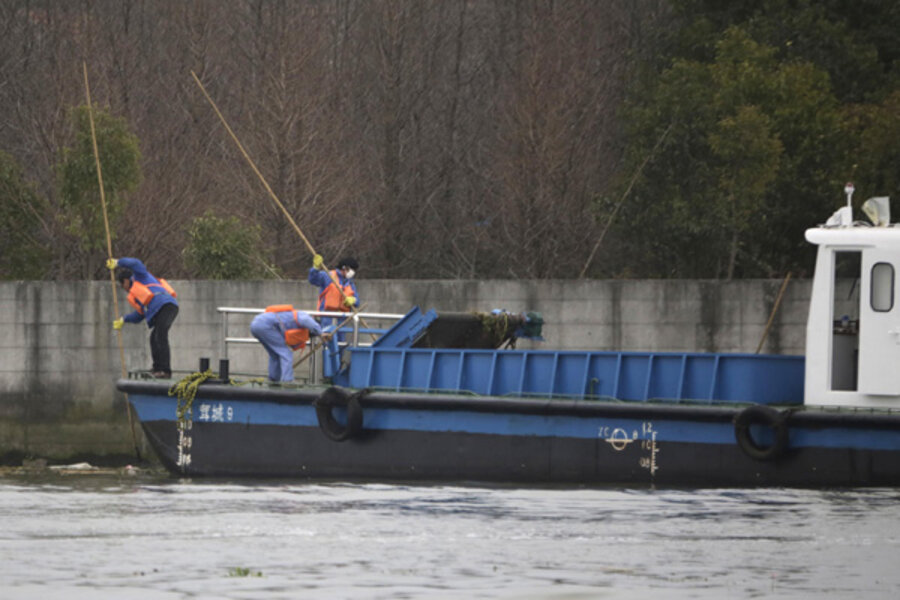

Here’s a riddle for you: When is the discovery of 2,813 dead and rotting pigs in a major city’s water source not a public health problem?
Answer: When the discovery is made in China.
The Shanghai water bureau, which oversees the water consumed in China’s largest city, was insisting on Monday that tap water derived from the Huangpu River met national standards despite the presence of the decomposing pigs.
All I can say is that I am glad I live in Beijing, not Shanghai.
Truly disgusting photographs of bloated porcine carcasses on a riverbank have appeared in many Chinese papers and websites, drawing attention to what seems – believe it or not – to be a relatively common occurrence.
When pigs die of disease, farmers who cannot be bothered to bury the animals just toss them into the nearest river.
Local residents of one pig-rearing village upstream from Shanghai told the national broadcaster China Central Television on Sunday that disposing of dead pigs in the river was a common practice. “After the pigs died of illness, [they] just dumped them in the river … constantly. Every day,” one villager said.
“They are everywhere and they smell very bad,” the villager added.
Thousands of pigs in the Shanghai area have succumbed to epidemic disease in recent months, according to the Jiaxing Daily, a government-run paper in a hog-raising region southwest of Shanghai.
Last week the paper reported that more than 18,000 pigs had died since the beginning of the year in Zhulin, a village in the Jiaxing district. It was not immediately clear how many of them had been legally disposed of and how many had been thrown into the river.
But in a report last week, the paper quoted one pig farmer as saying that “when things are busy,” he and his fellow farmers do not bother to call the local veterinary services to take the corpses away and just “throw them away where we can.” In the summer, he added, the smell of rotting meat is sometimes so strong that villagers cannot open their windows.
Deepen your worldview
with Monitor Highlights.
Politics with respect
Get political stories with respectful analysis.
There‘s a world of new ideas in every
Books newsletter.
There‘s more to life, enrich yours with
Culture & Learning weekly.
Follow humanity‘s discoveries with
Science & Nature stories in your inbox.
Gain a spiritual perspective
from the stories in your inbox.
Want to understand the deeper impact of critical events? Learn the Monitor‘s insight.
Already a subscriber? Log in to hide ads.
More worryingly, the paper said, many readers had called the editorial desk’s hotline to report pig carcasses abandoned by the roadside or in water channels that had mysteriously lost their hind legs overnight.
“What if they were cooked in a restaurant?” the newspaper article wondered.

 Why an octogenarian’s eviction has sent Spaniards into the streets
 South Koreans turn museum artifacts into cosplay (video)
 In Gaza, farmers rescue roots buried under rubble to grow fruit again
 Houthi militia now leads Iran’s ‘Axis.’ But how much can Tehran count on it?
 From the MagazineWhy more young Indians are doubting the value of education
 Recounting cockpit struggle on FlyDubai flight, Israeli passengers return home
 Recounting cockpit struggle on FlyDubai flight, Israeli passengers return home
 Trump is moving fast and breaking things. He could pay in November.
 How colleges are responding to Trump administration’s ‘call to action’
 As MAGA turns toward ‘heritage Americans,’ Ramaswamy hopes it doesn’t leave him out
 Hoping to push the US away, Iran’s strategy is to go on the offensive
 The US wants a Ukraine peace deal. Here’s why Russia isn’t biting.