






Not true, Mitt Romney: History shows business experience doesn't make a good president
Mitt Romney has derided President Obama for lacking the business experience he claimed as 'essential to his task.' That's a popular GOP message, but it's not true. America's best-rated presidents weren't businessmen, and those with the most business success rank among the worst.
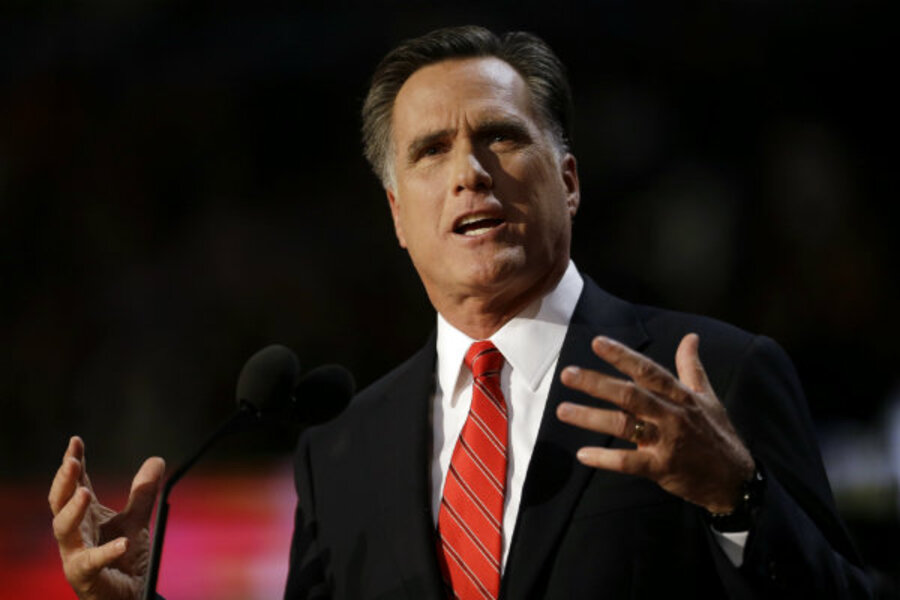
Good presidents need experience in the business world, right? Wrong. Of all the GOP’s campaign-season talking points, this one is the easiest to debunk.
The assumption was on vivid display at last week’s Republican National Convention, where nominee Mitt Romney – a former private equity manager – contrasted his resume to President Obama’s. “He took office without the most basic qualification that most Americans have and one that was essential to his task,” Romney said, criticizing Mr. Obama. “He had almost no experience working in a business.”
But it’s simply false to say that a business background is “essential” to succeeding as a president. Since 1900, only five of our 20 presidents had significant business experience when they entered the White House: Herbert Hoover, Harry Truman, Jimmy Carter, and the two Bushes.
Notably missing are the figures whom Americans routinely identify as the best 20th-century presidents: Theodore and Franklin Roosevelt, Dwight Eisenhower, John F. Kennedy, and Ronald Reagan. Of the businessmen-presidents, indeed, only Truman usually makes it into pollsters’ Top Ten. And he was the worst businessman of the lot.
The best one was surely Hoover, who remains a symbol of presidential ineptitude for his ham-handed reaction to the 1929 stock market crash and ensuing Great Depression. Before that, however, he made millions in the global mining industry. A peripatetic traveler, he moved from Australia to China to England in search of better opportunities.
He found them, too. Logging over 5,000 miles across the Australian bush in a quest for gold, he acquired a $1 million mine that would generate $65 million for his company. In a passage that could be lifted from a Mitt Romney speech, Hoover later recalled the “sheer joy” of “creating productive enterprises” during these early years.
And like Romney, who often closed or downsized unprofitable enterprises that he acquired while at Bain Capital, Hoover often let people go in the service of the bottom line. In Australia, when some of his workers went on strike, he boasted about firing them and importing Italian laborers to take their place. He was more upset about dismissing a 72-year-old accountant on his staff, Hoover wrote to a friend, “but I have to get things in shape for the company.”
And so he did. By the time he got to London, where he assumed a top position in the firm at the age of 27, a newspaper called Hoover “the highest salaried man of his years in the world.” At age 33 he went into business on his own, earning even more. “If a man has not made a million dollars by the time he is forty,” Hoover said, “he is not worth much.”
By that measure, Harry Truman was truly worthless. Investing $15,000 in a men’s clothing store in Kansas City, he lost about twice that sum and closed the store after just two years. He also tried his hand in oil drilling but failed to locate a profitable well; if he had succeeded, Truman later reflected, he would never have entered politics.
The next two businessmen-presidents, Jimmy Carter and George H.W. Bush, were much better at business than Harry Truman; but by most accounts, they were much worse presidents, though each had notable foreign policy triumphs. Mr. Carter actually started his own side enterprise at the ripe age of five, hawking boiled peanuts from his father’s farm on the streets of Plains, Georgia.
By the time he was nine, Carter was already speculating in cotton bales; soon after that, he started acquiring rental properties. He eventually diversified the family farm into a million-dollar-a-year business, selling fertilizer and insurance as well as peanuts.
Like Truman, meanwhile, George H.W. Bush went into the oil business; but unlike Truman, Bush actually struck oil. Starting in Texas, where his company dug 127 wells, Mr. Bush pioneered offshore drilling in the Gulf of Mexico. By the time he was 30, he was a millionaire.
His son’s business career was more checkered, buoyed by the family name as much as anything else. George W. Bush lost nearly a million dollars in an oil venture but was bailed out by another company, which enlisted him as a consultant to land lucrative drilling contracts in the Middle East. He had more success as co-owner of the Texas Rangers, earning $15 million in profits when he sold his share of the team in 1998.
But even many Republicans now rank George W. Bush as a middling-to-poor president. In a recent Gallup poll, just 46 percent of GOP respondents gave him a positive rating. That’s why the Republicans kept him under wraps at their convention.
Deepen your worldview
with Monitor Highlights.
Politics with respect
Get political stories with respectful analysis.
There‘s a world of new ideas in every
Books newsletter.
There‘s more to life, enrich yours with
Culture & Learning weekly.
Follow humanity‘s discoveries with
Science & Nature stories in your inbox.
Gain a spiritual perspective
from the stories in your inbox.
Want to understand the deeper impact of critical events? Learn the Monitor‘s insight.
Already a subscriber? Log in to hide ads.
But the Democrats made another ex-president their keynote speaker! Bill Clinton wasn’t a businessman, but he turned out to be a pretty darned good politician. So whatever you think of Barack Obama, it’s time to stop harping on his lack of entrepreneurial experience. Ronald Reagan didn’t build businesses, either, but 90 percent of Republicans regard him favorably. Go figure.
Jonathan Zimmerman is a professor of history and education at New York University. He is the author of “Small Wonder: The Little Red Schoolhouse in History and Memory” (Yale University Press).

 The Monitor's ViewOne of Ukraine’s winning principles
 The Monitor's ViewMorocco welcomes women in leadership
 The Monitor's ViewWhen students rise up, integrity might prevail
 The Monitor's ViewInnovation’s secret sauce: Less fear, more forgiveness
 The Monitor's ViewThe Swiss take a stand on neutrality
 The Monitor's ViewThe renewed roots of election integrity
 Recounting cockpit struggle on FlyDubai flight, Israeli passengers return home
 Trump is moving fast and breaking things. He could pay in November.
 How colleges are responding to Trump administration’s ‘call to action’
 As MAGA turns toward ‘heritage Americans,’ Ramaswamy hopes it doesn’t leave him out
 Hoping to push the US away, Iran’s strategy is to go on the offensive
 The US wants a Ukraine peace deal. Here’s why Russia isn’t biting.