






Why Sinai mosque attack is seen as a major ISIS miscalculation
To gain power, ISIS has a history of exploiting sectarian divides. But the sheer carnage of the attack on a mosque frequented by Sufi Muslims appears to be alienating ISIS's base, even among Sinai's downtrodden.
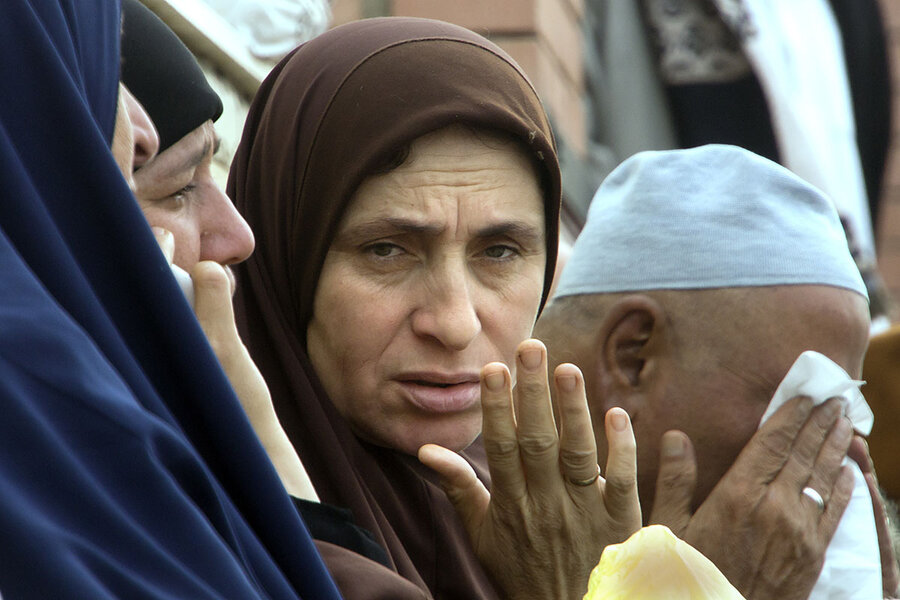
The Sinai mosque attack appears to represent a strategic miscalculation by the Islamic State and its affiliates, the leading suspects in the deadliest act of terror in Egypt’s history.
By waging war on a centuries-old Islamic order and attacking a common ritual of Muslim life – Friday prayers – ISIS is not only alienating the very audience it is trying to recruit, say analysts, but is turning neutral parties into enemies, potentially aiding the very government it is fighting.
In the attack on the Al Rawda mosque frequented by Sufis, ISIS signaled it had found an “enemy” with which it could rally citizens in Sunni-majority states similar to the way it has enflamed sectarian tensions in Shiite-Sunni communities in Iraq and Syria.
But the attack, which killed more than 300 people and put a decades-old rivalry between Islamic ultraconservatives and mystics front and center, has led to widespread condemnation of the persecution of Sufis.
ISIS has frequently listed Sufis among “heretics” and “soothsayers.” In 2016, the group executed a 97-year-old Sufi cleric in Sinai, and in the January issue of its online Rumiya magazine it listed the Al Rawda mosque among Sufi “lodges” and places of worship to be targeted.
“They were unable to create a sectarian war between Christians and Muslims, and now they are just targeting Muslims writ large, irrespective of local dynamics,” H.A. Hellyer, senior nonresident fellow at the Atlantic Council in Washington and an associate fellow at the Royal United Services Institute in London, says via email.
“I think this is a bit of desperation, to be honest.”
Long-time target of Salafists
Although the violence is new, the vitriol and language are not.
Denouncing Sufis as “heretics” has become a calling card of hard-line Salafists of many stripes over the past two decades. The ultraconservative Sunni sect equates the Sufi movement’s veneration of clerics, tombs, and spiritual festivals to “polytheism” and “idolatry.”
In the power vacuums of post Arab spring Arab states, Salafi groups, backed by Gulf clerics, targeted Sufi shrines, tombs, and mosques in Tunisia, Libya, and Egypt. ISIS has taken the campaign a step further by using violence, demolishing Sufi mosques in Syria, assassinating Sufi clerics in the Sinai, attacking a shrine in Pakistan, and now the mosque attack.
In countries such as Egypt, where according to experts there are 3 million official members of Sufi orders and 15 million who identify with the movement, ISIS’s call to arms against Sufis has fallen flat. Sufi heritage runs deep in North Africa and is tied to local traditions and customs that even predate Islam.
Sufi practices, such as celebrating the Prophet Muhammad’s birthday, to be observed by millions of Muslims this Thursday and Friday, and the Hijri calendar New Year have become pillars in many Arab and Muslim communities, which unlike Salafists or ISIS see them as acceptable.
While some Sunni Arabs may see Shiites as an extension of a hostile Iran, few would single out Sufis as a “threat” to Islam or the Arab world. Friday’s attack has led to an outpouring of support to those who identify themselves as Sufis.

“It is a very popular religious practice, and it is a popular religious order in Egypt,” says Omar Ashour, visiting professor of security studies at the Doha, Qatar-based Arab Center for Research and Policy Studies. “By this, the group is making an enemy of a large portion of the population.”
The use of violence against Sufis, has forced many hard-line groups, themselves anti-Sufi, to condemn the attacks, exposing their own stances on Sufis to be criticized as “extreme.”
Adding to the political fallout from the attack is the fact that the mosque, although founded by a Sufi order, was frequented by non-Sufis and Sufis alike.
Mosques, although they may be founded by certain communities, are open to all Muslims no matter what school or order they follow. On Friday, the Al Rawda mosque was full of men, women, and children praying before Friday lunch, a ritual across the Arab and Muslim world that transcends boundaries, schools, orders, or doctrines.
It may be the reason, analysts say, that ISIS and its affiliates have yet to claim responsibility for the attack – and even Al Qaeda supporters are criticizing it.
‘Turning point’
In the sheer carnage and killing of innocents in Friday’s attack, experts say ISIS may not only have lost its target audience, but has pushed them to the side of the government. It would be a strategic loss for ISIS, which has thrived by gaining the trust of disenfranchised communities across the Arab world.
In the Sinai, local communities and tribes have been largely cut off from Cairo, seeing little development, investment, or job opportunities over the past two decades. Groups aligned with ISIS such as Ansar Bait al-Maqdis, now known as ISIS Sinai Province, promised to provide protection against the government. The Egyptian military’s response has been blunt and harsh, an at times indiscriminate campaign that has resulted in widespread civilian casualties and arrests, and allegations of torture, bringing life to a halt.
Caught between ISIS militants and the military regime, most citizens remained neutral, wary of getting involved. This has allowed Sinai Province, which numbers some 1,500 members, mobility in the region. After Friday, this may change.
“I think it is a turning point, as we may see a major backlash,” says Professor Ashour.
“So far in Sinai Province, the clan and tribal support has been divided about ISIS, and the majority is neutral, without large support for the regime. This could change.”
Already, Friday’s attack has united Sinai tribes in opposition to ISIS, many signing up to join the Egyptian military’s operations and publicly urging all tribesmen to join the fight against ISIS.
Over the weekend, the Union of Sinai tribes, a grouping of one-dozen clans formed in the face of the rising influence of ISIS, issued a statement calling on its followers to join the military in its operations against militants south of Rafah, warning ISIS and jihadists that “we will not sleep until we cleanse our land of every last takfiri [apostate].”
“We call on all men and youths of Sinai tribes to join their brothers … to coordinate a greater operation with the army to completely end this black terrorism,” the statement read.
“Our men will not sleep until you are punished for your crimes. We do not have courts or prisons,” said the statement, which vowed, “we will kill you and not take you with mercy.”
Challenge for Egypt
Such support from ISIS’s erstwhile recruiting base, no matter its prior reservations, would significantly aid Egypt, which has struggled for three years to put down the Sinai Province insurgency.
“I think that following Friday’s attack, it will be increasingly unlikely that anyone in the Sinai is going to back anything other than the effort to defeat ISIS in the Sinai, irrespective of any grievances they have,” says Dr. Hellyer.
But it remains to be seen whether Arab states can take advantage of the potential shift in public opinion to build broader support for their campaigns against ISIS. In Egypt, the military has been heavily reliant on missile strikes and tanks to counter the insurgency, causing high amounts of civilian casualties without providing local communities alternatives or incentives to aid Cairo’s efforts.
Deepen your worldview
with Monitor Highlights.
Politics with respect
Get political stories with respectful analysis.
There‘s a world of new ideas in every
Books newsletter.
There‘s more to life, enrich yours with
Culture & Learning weekly.
Follow humanity‘s discoveries with
Science & Nature stories in your inbox.
Gain a spiritual perspective
from the stories in your inbox.
Want to understand the deeper impact of critical events? Learn the Monitor‘s insight.
Already a subscriber? Log in to hide ads.
Should President Abdel Fattah al-Sisi’s government extend a hand to an injured community, it may finally sway the campaign in Sinai and prevent ISIS’s expansion westward into Upper and Lower Egypt.
Yet in his public address after the attack, President Sisi indicated that his government was not going to change course in the Sinai, vowing to respond with “the utmost force.”

 Why an octogenarian’s eviction has sent Spaniards into the streets
 South Koreans turn museum artifacts into cosplay (video)
 In Gaza, farmers rescue roots buried under rubble to grow fruit again
 Houthi militia now leads Iran’s ‘Axis.’ But how much can Tehran count on it?
 From the MagazineWhy more young Indians are doubting the value of education
 Recounting cockpit struggle on FlyDubai flight, Israeli passengers return home
 Recounting cockpit struggle on FlyDubai flight, Israeli passengers return home
 Trump is moving fast and breaking things. He could pay in November.
 How colleges are responding to Trump administration’s ‘call to action’
 As MAGA turns toward ‘heritage Americans,’ Ramaswamy hopes it doesn’t leave him out
 Hoping to push the US away, Iran’s strategy is to go on the offensive
 The US wants a Ukraine peace deal. Here’s why Russia isn’t biting.