






Can Saudi-Israel peace talks learn lessons from the past?
Thirty years after the ill-fated Oslo Middle East peace deal was signed, a new generation of negotiators should recall that political leadership is key.
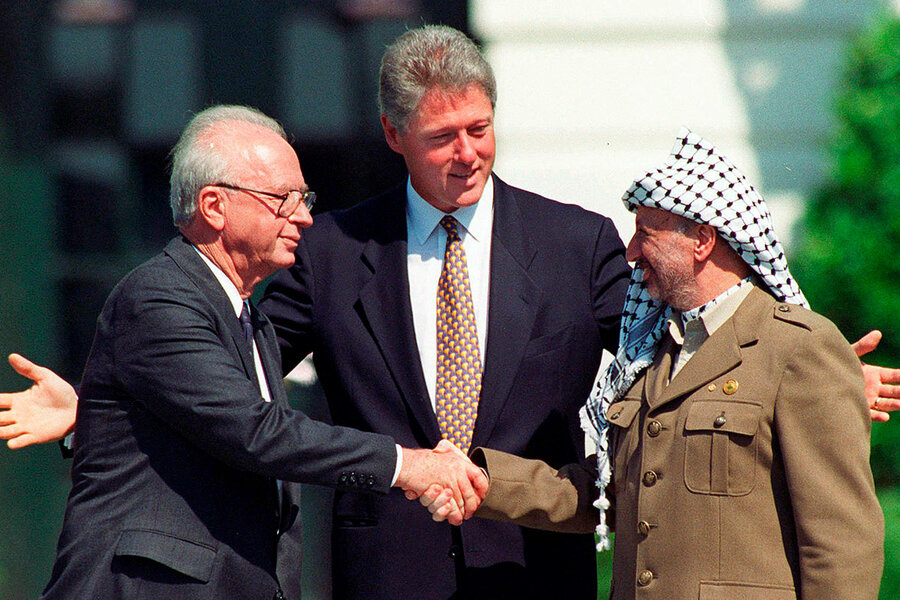

“Welcome to this great occasion of history and hope.”
Those words, spoken by former U.S. President Bill Clinton on the south lawn of the White House 30 years ago this week, did not sound wildly hyperbolic at the time. Flanking him, after all, were the bitterest of Mideast enemies: Israel’s Prime Minister Yitzhak Rabin and Palestine Liberation Organization Chairman Yasser Arafat.
And they were committing to embark on the road to peace – the Oslo process, so called because the declaration of principles the leaders were signing had been hammered out in secret talks in Norway.
The broad terms of a Mideast peace deal have been clear for 30 years. But do today’s Palestinian and Israeli leaders have the courage to persuade their peoples to compromise?
Mr. Clinton’s words ring hollow now. Israeli-Palestinian coexistence seems more distant than ever; Oslo’s vision of two sovereign states living side by side in peace is even further away.
Yet both sides know that the broad terms of the deal they tried to achieve in the seven fraught years after that sunny afternoon in 1993 still represent the only realistic path to peace.
The immediate challenge is to keep that path from being closed forever.
The latest salvage attempt is a component of the only Arab-Israeli negotiation that is still alive: a complex, U.S.-mediated effort to secure a landmark peace deal between Israel and Saudi Arabia.
Israel’s Prime Minister Benjamin Netanyahu dearly wants a formal peace treaty with the leading Arab and Islamic power. But as head of the most right-wing coalition in Israel’s history, he also wants the door kept firmly shut on a two-state peace deal with the Palestinians.

The Saudis and Americans, at least so far, have told him that he can’t have both.
Yet even if the door to Israeli-Palestinian negotiations is left ajar, a deeper question remains. Is peace itself, the kind of deal promised on the White House lawn, still possible?
Having followed that first failed process from the outset – and having gotten to know leading figures on both sides – my own sense is “yes ... if just barely.”
But success will hinge on learning Oslo’s lessons.
The substantive issues are undeniably difficult: security; final borders; the growing numbers of Israeli settlers on the West Bank, the intended core of a Palestinian state; Palestinian claims to a “right to return” to present-day Israel; and the status of the holy city of Jerusalem.
Still, by the time the Oslo deal foundered, the contours of a workable deal were emerging: the lion’s share of the West Bank as a Palestinian state, along with Gaza, to Israel’s south; shared sovereignty over Jerusalem; a limited, symbolic return of Palestinian returnees – all to be set out in a formal, final peace treaty.
The ultimate obstacles – and the real challenges for future peacemakers – came on two other fronts: domestic politics and leadership.
First, the politics. Making peace meant overcoming visceral opposition to the very idea of compromise in what for many, on both sides, is an existential conflict.

In Israel, opposition grew with each step. And when Mr. Rabin agreed in 1995 to a series of withdrawals from the West Bank, the assault turned uglier. The day before that agreement passed in parliament, the then-leader of the opposition – Mr. Netanyahu – addressed a rally in the heart of Jerusalem. Some in the crowd were shouting, “Death to Rabin!”
As Mr. Rabin left a pro-peace rally in central Tel Aviv a few weeks later, a young ultranationalist Israeli opposed to Oslo shot and killed him.
On the Palestinian side, Mr. Arafat faced no similarly overt threat. But there was opposition from harder-line PLO members and increasingly influential Islamist political groups.
And that is where the issue of leadership came into play: because the Oslo plan, and any future peace effort, could succeed only if leaders with grassroots credibility were willing to make a sustained, public case for compromise.
Mr. Rabin and Mr. Arafat had credibility: the Israeli leader as a battlefield veteran, former chief of staff, and defense minister, and the PLO chief as the very symbol of armed opposition to Israel.
Mr. Rabin, though reticent at first, did begin to make the case for peace at the rally that ended in his death. Mr. Arafat never abandoned reticence. Never, after his stirring words at the White House, did he make a forceful case for peace.
Thirty years later, the discouraging news is that there is no sign on either side of leaders with the credibility and will to make peace.
Mr. Arafat’s successor, Mahmoud Abbas, is increasingly isolated, and many Palestinians view the Palestinian Authority he leads as deeply corrupt. While Mr. Netanyahu’s right-wing credentials give him potential credibility, he has shown no interest in making the case for peace.
Still, one thing is changing: A new generation of Palestinians and Israelis have to face a new reality.
Palestinians have seen the number of Israeli settlers on the West Bank grow hugely since Oslo: There are now more than a half-million. Palestinians’ daily lives are increasingly constrained by Israeli restrictions and blighted by violence, including attacks by settlers.
Deepen your worldview
with Monitor Highlights.
Politics with respect
Get political stories with respectful analysis.
There‘s a world of new ideas in every
Books newsletter.
There‘s more to life, enrich yours with
Culture & Learning weekly.
Follow humanity‘s discoveries with
Science & Nature stories in your inbox.
Gain a spiritual perspective
from the stories in your inbox.
Want to understand the deeper impact of critical events? Learn the Monitor‘s insight.
Already a subscriber? Log in to hide ads.
In Israel, the impetus is demographic. If the country abandons the idea of a negotiated peace and exerts permanent rule over the West Bank, Jews could eventually become a minority in such an enlarged Israel. They would face a stark choice between being a Jewish state or remaining a one-person-one-vote democracy.
It may be that – regardless of leadership – the logic of peace will eventually become implacable.

 Why an octogenarian’s eviction has sent Spaniards into the streets
 South Koreans turn museum artifacts into cosplay (video)
 In Gaza, farmers rescue roots buried under rubble to grow fruit again
 Houthi militia now leads Iran’s ‘Axis.’ But how much can Tehran count on it?
 From the MagazineWhy more young Indians are doubting the value of education
 Recounting cockpit struggle on FlyDubai flight, Israeli passengers return home
 Recounting cockpit struggle on FlyDubai flight, Israeli passengers return home
 Trump is moving fast and breaking things. He could pay in November.
 How colleges are responding to Trump administration’s ‘call to action’
 As MAGA turns toward ‘heritage Americans,’ Ramaswamy hopes it doesn’t leave him out
 Hoping to push the US away, Iran’s strategy is to go on the offensive
 The US wants a Ukraine peace deal. Here’s why Russia isn’t biting.