






Delhi election: Why an idealistic 'Common Man' beat PM Modi's party
The ruling BJP and Congress, India's two political giants, were defeated Tuesday by an anti-corruption party led by a former tax inspector.
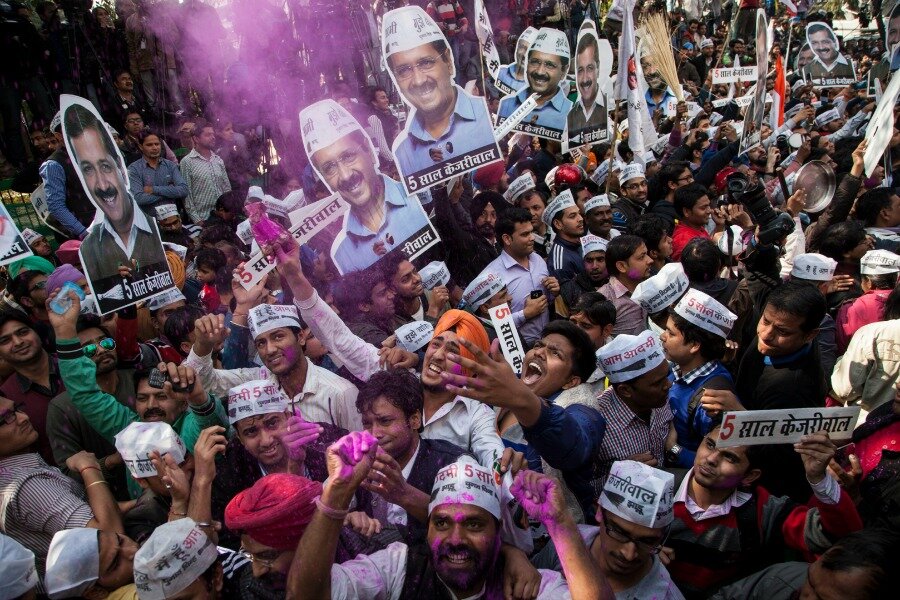
He's known as India’s corruption buster. And now Arvind Kejriwal, a youthful-looking former tax inspector and winner of Asia’s equivalent of the Nobel Prize, has pulled off a stunning near-sweep in New Delhi's local elections on Tuesday.
The Aam Aadmi, or "Common Man," party won 67 of 70 seats in New Delhi, the largest single victory ever in India's capital. The party's victory also marks the first major loss for the Hindu nationalist BJP party since its own sweep of India last spring, which brought Prime Minister Narendra Modi to power.
The scale of victory for the young, idealistic party that champions local needs – including clean water, electricity, and security for women, as well as a “clean hands” anti-graft agenda – suggests the lure of Mr. Modi’s BJP is not necessarily a deep one. The loss is being called the end of Modi’s honeymoon less than two weeks after he hosted US President Obama.
The Common Man party’s popular majority of 54 percent shows that Kejriwal’s support appears to transcend class and religious categories, though whether he can transcend Delhi politics and exercise power outside the capital remains unclear.
“I voted for Kejriwal because BJP has failed us,” says Anil Kumar, a shopkeeper who voted for the BJP last year. “Narendra Modi promised us that his government will be all about good governance and inclusive growth. Now his party men only talk the language of hate and arrogance.”
A surprise victory
Tuesday’s election marked the first time that Congress, the venerable party associated with the liberation movement of Mohandas Gandhi, failed to win a single seat in Delhi.
Yet it's not the first time that AAP and Kejriwal have swept the polls here. AAP stunned India in 2013 by winning 28 seats in Delhi and defeating the ruling Congress party. Kejriwal then clashed with the federal government over an anti-corruption bill and walked out of office less than two months later. He has since apologized and vows not to leave again.
The success of the Common Man party stems from its sustained campaign against corruption combined with a dedicated army of volunteers. Analysts say Kejriwal also benefited from the perceived arrogance or overconfidence of the BJP, with Modi often deriding Kejriwal as no match for his own persona and political intelligence.
“One man with a muffler has defeated the big national parties and has stripped the aura of Mr. Modi’s invincibility,” said Karan Singh, a senior leader of the Congress party, referring to the scarf worn by Kejriwal. “He has achieved something spectacular. He has demolished the perception that Mr. Modi cannot be defeated."
Origins of a 'Common Man'
Kejriwal existed for years under the political radar in India, surfacing from time to time to take up “transparency” issues like clarifying the Right to Information Act.
But even after winning the Ramon Magsaysay award in 2006, no one really knew his background: that he was born in 1968 in a middle class family from Haryana state in the north and graduated from the Indian Institute of Technology with a degree in mechanical engineering, moving then to work for the Tata group and then the Indian public tax service.
Deepen your worldview
with Monitor Highlights.
Politics with respect
Get political stories with respectful analysis.
There‘s a world of new ideas in every
Books newsletter.
There‘s more to life, enrich yours with
Culture & Learning weekly.
Follow humanity‘s discoveries with
Science & Nature stories in your inbox.
Gain a spiritual perspective
from the stories in your inbox.
Want to understand the deeper impact of critical events? Learn the Monitor‘s insight.
Already a subscriber? Log in to hide ads.
Kejriwal entered politics in 2012 and championed transparency and anti-corruption. He launched a party that brought together activists, youth, and poor people, and his anti-graft ideas caused a stir nationwide. His party’s symbol is a broom, a reference to its origins as an anti-graft campaign group.
Those close to Kejriwal say the tipping point in his career came when he joined forces with Anna Hazare, an anti-corruption crusader. While Ms. Hazare did not join politics, Kejriwal launched the AAP as an alternative to mainstream national political parties.

 Why an octogenarian’s eviction has sent Spaniards into the streets
 South Koreans turn museum artifacts into cosplay (video)
 In Gaza, farmers rescue roots buried under rubble to grow fruit again
 Houthi militia now leads Iran’s ‘Axis.’ But how much can Tehran count on it?
 From the MagazineWhy more young Indians are doubting the value of education
 Recounting cockpit struggle on FlyDubai flight, Israeli passengers return home
 Recounting cockpit struggle on FlyDubai flight, Israeli passengers return home
 Trump is moving fast and breaking things. He could pay in November.
 How colleges are responding to Trump administration’s ‘call to action’
 As MAGA turns toward ‘heritage Americans,’ Ramaswamy hopes it doesn’t leave him out
 Hoping to push the US away, Iran’s strategy is to go on the offensive
 The US wants a Ukraine peace deal. Here’s why Russia isn’t biting.