






Is the brightest known galaxy ripping itself apart?
The brightest galaxy ever observed is in danger of unravelling. But beyond the fate of this distant corner of the cosmos, what can this insight contribute to our understanding of the universe?
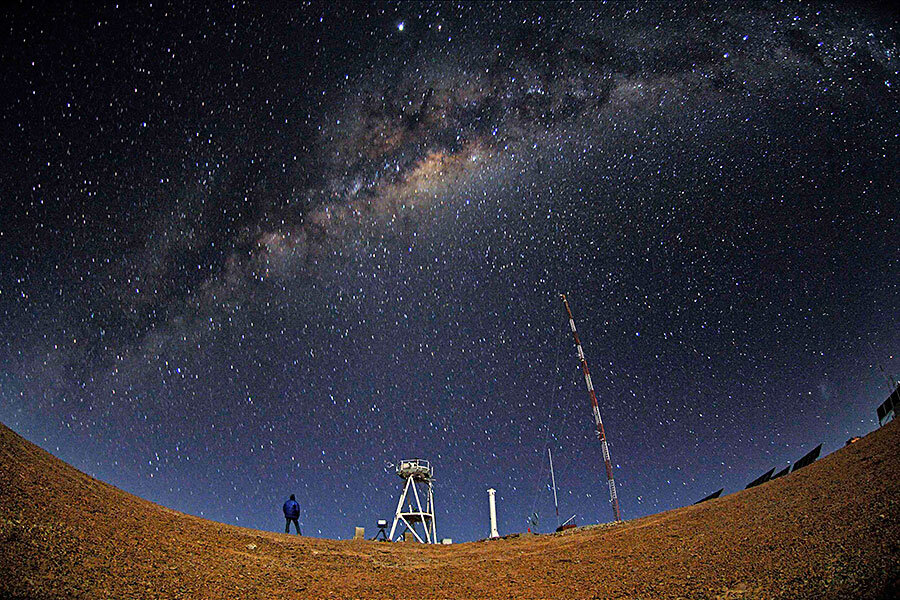
The most luminous galaxy in the universe is in danger of tearing itself asunder, new research in The Astrophysical Journal Letters shows.
The galaxy, called quite simply W2246-0526, lies 12.4 billion light-years from Earth, and is so consumed by turmoil that it lies in danger of ejecting its entire supply of star-forming gas.
The discovery was made by a team using cutting-edge technology in the Atacama desert of Chile, and the implications of their work are important for what it can teach us about the fate of both W2246-0526 and galaxies in general.
“This discovery provides a new insight into the processes through which galaxies evolve” Roberto Assef, co-author of the study and an astronomer with the Universidad Diego Portales in Santiago, Chile, tells The Christian Science Monitor in an e-mail interview.
The researchers, based at the Atacama Large Millimeter/submillimeter Array (ALMA), were following on from work done by NASA.
The American space agency’s WISE (Wide-field Infrared Survey Explorer) spacecraft had already analysed W2246-0526, revealing that the infrared light pouring from the galaxy is shining as brightly as more than 300 trillion suns.
What ALMA has enabled for the first time is a study of the actual motion of the galaxy’s interstellar medium, the gas and dust that swirls between the stars.
“It is known that every galaxy is formed having large amounts of interstellar gas from which new stars are constantly born,” says Dr. Assef.
“Such is the case for the Milky Way, for example, where new generations of stars are constantly being formed. Through their life, galaxies will eventually lose their gas and, hence, lose the ability to form new stars.”
What we lack, says Assef, is the understanding of how this happens.
The evidence gathered suggests that W2246-0526 has at its center a “voraciously feeding supermassive black hole”.
The unparalleled brightness of this galaxy is being powered by a tiny, intensely powerful disk of gas spinning round the supermassive black hole. The light exploding from this disk is first absorbed by the surrounding dust and then thrown out into the universe on the infrared wavelength.
“The powerful infrared energy emitted by the dust then has a direct and violent impact on the entire galaxy, producing extreme turbulence throughout the interstellar medium”, said Assef, according to the press release.
But all of this fresh insight is only available thanks to ALMA, a telescope consisting of 66 antennae that work together to function as one.
“It’s the most powerful telescope of its kind ever constructed,” Charles Blue of the National Radio Astronomy Observatory (NRAO) tells The Christian Science Monitor in a phone interview.
The NRAO is the North American arm of ALMA, though the telescope itself is entirely Chile-based.
“Its function is to look at the cold dark universe that’s not necessarily seen in optical light,” says Mr. Blue. “It can resolve very fine details to a level we just couldn’t see before”.
ALMA is based at 5,000 meters above sea level, in the Atacama desert. It was placed in such inhospitable terrain to provide it with a very high, dry site - critical to the telescope's operation.
Deepen your worldview
with Monitor Highlights.
Politics with respect
Get political stories with respectful analysis.
There‘s a world of new ideas in every
Books newsletter.
There‘s more to life, enrich yours with
Culture & Learning weekly.
Follow humanity‘s discoveries with
Science & Nature stories in your inbox.
Gain a spiritual perspective
from the stories in your inbox.
Want to understand the deeper impact of critical events? Learn the Monitor‘s insight.
Already a subscriber? Log in to hide ads.
It first came online in 2013, but only came into possession of its full capabilities about a year ago.
"Only ALMA, with its unparalleled resolution, can allow us to see this object in high definition and fathom such an important episode in the life of this galaxy,” said Manuel Aravena, also from the Universidad Diego Portales, and co-author of the study.
 With Artemis II back on Earth, what’s next for NASA?
 Russia sees opportunity in thawing Arctic. But it’s looking for partners, too.
 Difference Maker‘The tools to imagine solutions’: Science educator inspires Pakistani children
 Trump sees a ‘con’ in climate change. Xi sees cash.
 From the MagazineMake Oil Great Again? Even California drills as global climate action stalls.
 The ExplainerClimate money is flowing around the globe. Sometimes, corruption makes it disappear.
 Recounting cockpit struggle on FlyDubai flight, Israeli passengers return home
 Trump is moving fast and breaking things. He could pay in November.
 How colleges are responding to Trump administration’s ‘call to action’
 As MAGA turns toward ‘heritage Americans,’ Ramaswamy hopes it doesn’t leave him out
 Hoping to push the US away, Iran’s strategy is to go on the offensive
 The US wants a Ukraine peace deal. Here’s why Russia isn’t biting.